-{-_-}-

Showing posts with label Strategy. Show all posts

The strategy here is firstly knowing when things are going wrong (away from your vision and goal) and secondly finding the solution to making it right again

Life is awesome; if this changes then we have to eliminate the negative and strive for excellence

The strategy for success is having a strategy for success

Read More …


Life is pretty damn awesome as we get further into 2012 and all it has to offer, although it probably feels impossible to do everything you want.

It’s hard to even know where to start. This is where it helps to have a strategic mindset to help out a bit. As I’ve been thinking about what I want to get out of 2012 and how I can achieve it there are some principles I’ve come across that I feel would be good to share. In an upcoming post I will also raise the question of Zen living that will fall inline with the following 3 points:

Deferred lifestyle
If you have looked into individuals such as Richard Branson, Bill Gates and Steve Jobs they all have one commonality that jumps out before any other. The dream took priority; there was little if any delay in pursuing it. Whether it meant dropping out of prestigious educational institutions, entering multiple sectors or jumping into new markets.

Normal society doesn’t function in this way. It believes that we need to work as a form of continuous survival as opposed to working everyday in order to achieve our life’s goals and passions.

The key learning to take from this observation is don’t delay, just do (it). As Oscar Wilde said “no person is rich enough to buy back his past”, delaying therefore wastes this priceless gift.

As Willow Smith is demonstrating, she’s only 10 but she wants to go for her dream now and follow in Mum and Dad’s footsteps. I celebrate this.

Pareto Principle or more accurately Juran's Principle

This principle originates from an Italian economist (Vilfredo Pareto) his observation was that eighty percent of Italy’s wealth was generated by twenty percent of the population. Following this Joseph Juran recognised a universal principle he named “the vital few and trivial many.” The 80/20 as it’s also become known has become one of the most useful principles in modern day management. The principle also acts as an important lesson in life.

80/20 has been taken up by minimalist living, setting out to cut possessions and life’s activities down to the twenty percent that really matters. I know I’ve wasted a lot of time due to materialism and doing things that don’t really matter or act as a delay spurring a differed lifestyle. It’s always worth having a look at your personal and professional life and seeing how you can prioritise and focus on what really matters.

Tim Ferriss’s book The 4-Hour Workweek speaks about prioritisation and how it changed his life to become more effective and efficient to achieve his passions that he achieves not by asking himself “What do I want” or “What are my goals” but “What would excite me?”. When you’re able to focus on what really matters and excites you he’s proven what can be achieved i.e. Learning any language in 3 months.

Parkinson’s Law

As a final thought and something that nicely ties up these three observations. When outlining what you want to achieve it’s often hard to know when you want to achieve it. Especially after what we have just spoken about, you definitely don’t want to delay it and you don’t want to end up focusing on what is less important. As what is the pot of gold that justifies spending the best years of your life hoping for happiness in the last?

Parkinson ’s Law works to the principle that work expands to fill the time available for its completion. Cyril Northcote Parkinson, the famous British historian and author was qualified to make such a statement having worked in the British Civil Services seeing first hand how bureaucracy ticks. Bureaucracy itself is a by-product of our culture, due to the limiting belief that working harder is somehow better than working smarter or faster.

Work expanding to the time made available (physiologically speaking) means that if you give yourself two weeks to do a task that should only take a few hours, the task will become more daunting increasing in complexity along the way filling the time made available to it.

Parkinson’s Law as with this whole post has been an observation. If you start to set ridiculously tight deadlines to yourself it’s likely you won’t meet them and stress out while doing so. But by changing the perception of how work can be done avoiding what’s least important and taking more time off your deadlines than you usually would, can result in achievements you may never have thought possible.
One final thought I’d like to leave you with is from something I just saw on Sky movies, and something that rings true with me as I begin my first year completely separated from the restriction of an academic framework. With no mark scheme informing me of what direction to go to achieve what I want:

“Would you tell me, please, which way I ought to go from here?”

“That depends a good deal on where you want to get to,” said the Cat

“I don’t much care where........” said Alice

“Then it doesn’t matter which way you go,” said the Cat
Read More …

Following my most recent work blog post, I thought I’d add in a ‘StringTheory’ strategy.

First of all here’re some books that will be of interest if you liked the Engine blog post:

The Innovators dilemma – Looks into how disruptive innovation can damage great firms by changing the game in a way they failed to foresee

The Singularity is near – A film based on this book is now out, if the only reading you enjoy is this blog. It’s about intelligence becoming enhanced by the union of humans and machines  

The Physics of Star Trek – Basically put is Star Trek physically possible...... most technologies/technologists appear to have been inspired by the show as it is

Below is a screenshot from Blade Runner that’s set in the year 2019. Could LA look like this in 8 years?

I’ve shown this image as I wanted to make the point of how important SCI-FI is. From SCI-FI’s inspiration for the books above and its huge ambition for progress. LA is unlikely to look like the above in 8 years but it’s something that Philip Dick could imagine in the book the movie was based on Do Androids Dream of Electric Sheep? That other SCFI ‘imagineers’ could then design visually (Ridley Scott, Hampton Fancher and David Peoples).  

Although SCI-FI still has a bit of a stigma attached to it:

As of late though SCI-FI and what was once considered geeky has become more socially acceptable, as Hollywood has promoted it into the mainstream. Making millions from Marvel and DC comic books I read as a kid (something I didn’t promote around school).

The strategy here is simple. Embrace SCI-FI, embrace your inner geek. This doesn’t mean move into your parent’s basement and watch back to back Star Trek episodes, it just means embrace imagination and the fantasy of what could be, so you can “invent the future”.

An example of the difference in mindsets is highlighted in Frequently Asked Questions About Time Travel. 

 See you in the future. Where I hope you have a SCI-FI head on your shoulders.


Read More …

In the beginning there were commodities as the basis of the agrarian economy, the industrial revolution changed this as commodities became a raw material to manufacture goods. Goods have now become commoditised, with no care of who the goods were manufactured by. This has been reflected to the service sector with the sole care being price.

The shift that is now occurring away from this is towards an ‘Experience Economy’. The buying criteria for consumers are now being rendered by ‘Authenticity’.

As we begin to work smarter to create free time for ourselves to fill with experiences, the cost of this ‘free’ time will thus grow in value as we are driven to work longer and harder.

In 1972 Geoffrey Hoyle's book predicted what life would be like in 2010, it has now been reprinted with the title amended to 2011.

Among predictions of “vision phones” and “doing grocery shopping online”, one of the drastic wrong predictions in the 19th century from the industrial revolution was that as we became more mechanised it would go a bit further to earning us a life of leisure.

Hoyle's three day week for 2010 has failed to materialise. "People are going to have to work very hard. It's gone the other way. People are working seven days a week. I'm very pessimistic now," he says.

We have been unable to use mechanisation and technology to truly make our lives easier. If anything they have made our lives more complex creating more demands upon ourselves acting as the catalyst to escape this and create authentic life experiences.

When attempting to create more free time in this experience economy remember the value of free and how you can best appreciate it.
Read More …


The perception of the world has certainly changed as we have become to perceive it differently from:


to ‘The Blue Marble’:


Business understood this changed perspective as it became possible to do so via IT, transport and economic advancement. Building global empires taking advantage of what can't be found in their own back yards from cheaper land and labour to raw materials.

The strategic thinking behind globalisation doesn’t only apply to large scale organisations. This is the fists in a series of posts demonstrating how to use this ‘flat world’ in ways you perhaps may have never considered.


#1 Get yourself a virtual assistant

Whether in your personal or professional life I’m sure there are a lot of things you’d rather not spend your time doing. Why not not do it and spend more time doing what you do want to do.

As a lot of things that end up consuming a lot of time are web based this can be done via globalising your work load. Taking advantage of what big business has been doing for years.

Think about some time consuming tasks you could assign for fun (i.e. I’m going to assign the task of SEO for this blog), below are some sites to check out to get started:

US and Canada:

India:

Get in touch with how you get on, or if you’d rather not get your VA to do it for you.


Read More …

There’s a lot of information out there on the web. It’s not organised very well though. Data is certainly something that fuels the drive to present information more clearly e.g. Microsoft Pivot. We have surpassed the desktop, laptop and notebook to get more powerful portable information access through phones and tablets, with the filtering of information being made possible through the social web. Having said this there is still a lot more that can be done to increase the relevance of information and that is what we will now explore.

When augmenting our vision (when the technology is strong enough) eyeglasses can work in the opposite way to what Kal-El wore glasses for (that’s Kryptonian name for you non-geeks out there); as opposed to concealing special ability they enable it.


We are still learning more about the human eye e.g. some women can see four ranges of colours rather than three, known as a tetrachromat. This is something that augmented reality could enable as part of its iVision store (can you see what I did there).

Asking the question “How will it affect our personal information from the social web?” I see on par with asking – “Why do we wear clothes?” It’s not really because we want to keep warm, because that would infer that some days (as I’m British - most likely when I’m abroad) you’d come to the decision that it was too hot for clothes and that going commando would be the most comfortable option. But most of us wouldn’t do that. Clothes are therefore more about keeping some things hidden from people, as we live in a society of secrecy. This is similar to our discretion online when we choose to share some updates etc with some people and not others. However, this is something that we are moving further away from as the publication of personal information accelerates and can be related directly to you offline by augmenting our vision. From the 1st generation apps via phones and tablet interfaces/cameras and what I see as 2nd and 3rd generation that’s made possible through eye glasses and contact lenses that allows for permanent augmented vision; what will then become more important to you?, Your online presence or offline?, Or perhaps more accurately there will be no distinction between the two.

What I see for AR 2nd and 3rd generations:

Augmented reality can enable bionic vision giving us. Imagine on from top selling iPhone Apps like Angry Birds, buying augmented apps such as “tetrachromat” or “zoom for the eye” that mean you will be more enhanced than your fellow man.

There is the possibility to move on from what the internet allowed for shared thinking to shared sight, overlaying imagination with perception. Next time on the tennis court I’d love to get my hands on an augmented app that allows me to see what Roger Federer’s shot selection would be.

When it comes to our personal info I don’t want to see us ending up living in a penopticon. Having allowed for us to enhance the way we see the world, the downside is we may all be naked, unaware what way people are seeing us, using something like Recognizr or a successor.

We have had eye glasses since the 13th century. It’s time to knock things up a notch and use the data better, just let’s hope not to create a police state.

What are your views feel free to post them for all to see below, if not then it’s assumed you’re not in favour of becoming ‘naked on the web’:

Happy viewing.
Read More …

This is a strategic frame of mind. Simple really. If you think of most situations – A business idea you have, a girl you see at a bar, an athletic feat you wish to achieve, the concept is to gun for 10*. If you think medioca you’re going to meet a hell of a lot of competition, there are 6.7billion people in the world and most people aim or keep on track for mediocracy. There are a lot of reason for this; all I know is I do everything I can to gun for 10. Hopefully I can share my story one day, in the mean time here are a couple of stories I’ve used for motivation over the years and great examples of gunning for 10.

Alex Tew ‘Earning a million before university’


I’ll kick things off with Alex Tew. I found out about his million dollar home page almost as soon as it launched in 2005, the site could have been created with the most basic HTML understanding and it completely relied on the fact it was the first of its kind (which isn’t always a good thing). The concept of selling one million pixels to fund his upcoming fees at the University of Nottingham went on to earn $1,037,100, it was clearly no more than a fad, as a 16year old I saw no real reason to get excited about it.

What I didn’t see when I read the original FAQs when the first few had been sold to family and friends was that this kid was gunning for 10. He managed to generate some impressive PR and it went viral to generate enough traffic to excite advertisers, not before too long I saw him on Richard and Judy. If I remember rightly this was near the end of the auction session and he was selling his last 1000 pixels in an auction that came to reach $38,100. He set the objective of making a million before he went of to University; he gunned for 10 until he achieved it.

I checked out some recent news articles before writing this and it’s been mentioned more times than once that Alex Tew is one of the most annoying men on the internet. The strategy of simplicity is annoying, but it’s the complex way in which he implements his ideas that attracts investment and in turn made him a million, he goes with an idea and guns for 10 successful or not.

Mystery ‘becoming the best pick up artist in the world’


Your probably more likely to know this guy if you’ve read The Game: Penetrating the Secret Society of Pickup Artists or watched The Pick-Up Artist on VH1. A lot of the reasons why people’s PUA strategy flops at the first hurdle are that they don’t gun for 10. Like business if you don’t believe in your idea you haven’t got a chance, this will be the same in any set. Even if you’re game is as simple as Alex Tew’s one million dollar home page, if you give it your all with confidence and determination it will pay off.

Mystery aka Erik von Markovik was a guy that was a total flop when it came to women, depressed he could never find any girls interested in him. He therefore set a life time goal to become the best PUA in the world. This was achieved by intense devotion to PUA studying social dynamics among other psychological disciplines in order to use and learn in the field, gunning for 10 every time. After being a student of Neil Strauss the author of The Game he released his own book The Mystery Method: How to Get Beautiful Women into Bed receiving great acclaim earning millions in the process, particularly through his training boot camps, similar to the VH1 series.

He has scientifically broken down the art of the pick up and trained many others in the process to prove his worth. This is through a hell of a lot of work.

Both Alex Tew and Mystery are examples of setting a massively outlandish goal from less than desirable circumstances, which assisted them to push forward as hard as possible to achieve the outcome desired.
The strategic lesson from this is whenever implementing an objective, gun for 10, never look back and you never know you just might pull it off.

*Gun for 10 – To go for the best, the most ambitious feat comprehendible at the time in order to avoid meritocracy.
Read More …

The business world is changing. This change excites me as the balance between corporatocracy and the world in which it resides begins to strive for equilibrium; something I want to believe is possible in my lifetime. New design concepts such as Cradle to Cradle demonstrate the power of changing years of bad practice (the book itself is a polymer ‘not a tree’ and aptly is the name of the first chapter).

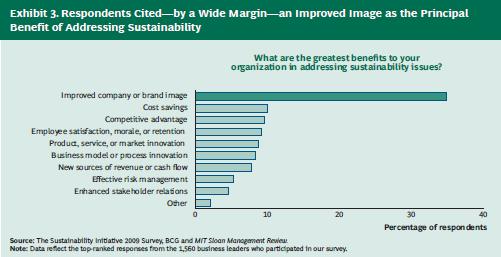
The business world however is fixed in its ways to out of date strategy, a reason why the graph below from MIT presents what it does with a very shallow view of the benefits. This is also why very few business schools in the world teach sustainability.


The path many businesses make is reflective of their leaders understanding of sustainability, the problem being there is a lot of old school business out there. This is unfortunately brushing up on the next generation not looking past the low hanging fruit opportunities. From shows such as The Apprentice, showcasing “Britain’s brightest business prospects”, with their money hungry attitude and ill conceived and implemented ideas that have never had any form of motivation behind them other than to achieve short lived profit maximisation.

In the western world this is mainly due to the short term financial pressures placed upon companies. In the eastern world financial value is placed over longer periods of time, this makes it easier to place value upon environmental pursuits as longer term investments (a reason why their P&L’s are getting increasingly stronger). Within a lot of businesses due to this short term frame of mind I find it hard to see who’s in control, the business owner or the corporation, it’s a destructive model.


Although there is a drive for change i.e. M&S Plan A, Nike Considered, Interface, Patagonia, BloomEnergy and Saatchi and Saatchi S. From leaders such as Adam Werbach that can see past ‘greening business strategy’. There currently isn’t even close to a 50/50 trade off with an anthropocentric approach much more likely than ecocentric. There needs to be an understood meaning of what sustainability means, as The BCG found, every business survey revealed no company agreed on establishing a single definition, ranging from environmental goals, economic, societal and political implications.


This agreement isn’t currently happening as ‘the market’ doesn’t place value upon truth and honesty of a businesses environmental impact, this will change though as the triple bottom line and transparency becomes central to operation. As the hot online start ups are demonstrating i.e. Facebook, YouTube, Mozilla,
WordPress and the concept of Foursquare. All of these help frame the businesses of the future with their common goal of sharing information easier, demolishing hierarchical business practice.

Paul Hawken’s recognises business and industry as one of the major culprits of the decline of the biosphere and the only institution powerful and persuasive enough to lead the world out of its ecological decline. There is a lot of strategic opportunity here and it’s not going to slow down any time soon, past the realms of ‘improved company or brand image’.

Success in business is all about gaining a competitive advantage. What The String Theory presents here though is this doesn’t apply that closely to the sustainability USP, but instead that sustainability is about striving together (as is the Latin meaning of competition – competere) to gain greater benefits from a less focused anthropocentric approach. This is where the striving together of sustainable strategy will begin to produce the best in class with longer term thinking and healthier operating businesses, gaining cost and differentiated advantage.

The link between development and environmental degradation can then be weakened for future generations. The fact is if you don’t join the movement you’re be left in the dust.

The Stone Age didn’t end because we run out of stones.

Read More …

I love business strategy. It started at A-level, from then I began to set myself strategic challenges. This post will demonstrate a strategic challenge I set myself at University. I wondered how easy it would be to fundamentally change a product (segments and motivation for purchase) without changing the core product at all.

At the time of thinking this I was a bit of a Red Bull fiend so applied the question towards Red Bull UK in the form of a massively edited 15,000 word report(available upon request).

The idea I would like to share is a reactive flanker strategy for market share growth within the saturating energy drink market, increasingly under threat from sports drinks. It builds off the Ogilvy and Mather Lucozade messaging as the dominate sports drink brand “Lucozade = science + passion” developing Red Bull’s “extreme” messaging to “Energizing hydration anywhere”.

In order to do this the flanker strategy needed to penetrate the conventional sport market, developing away from the extreme motivation without damaging its current customer base.

The output was:


Without changing Red Bull’s ‘off the shelf’ offering Red Bull 50/50 is an instructional brand that sits on a sales promo vehicle. Giving away free sport bottles to dilute a Red Bull 250ml can with 250ml water (give it a go).


Even if you don’t like this solution the 50/50 brand would be alongside the equivalent of 25% of Red Bull’s inventory (in the UK) on sports bottles acting as an ambient media vehicle achieving the challenge: 


Read More …